![]()
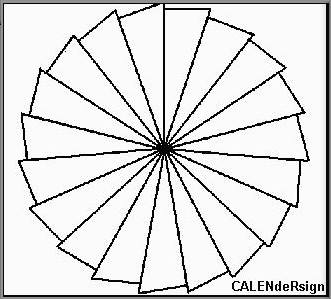
(daily way in the model 2.6 m)
The Earth, as the third planet counted from the centre of the solar system, encircles the sun at an average distance of about 149.6 million km and has a diameter of maximally 12,756 km. The earth is, up till now, still the only place in the universe where life has been found. Innumerable factors make the earth seem like a predestined place allowing humanity to develop. The earth's core most probably consists of nickel and iron, which, at a temperature of about 7000°C, is hotter than the surface of the sun. A liquid casing surrounds the core upon which, finally, the earth's crust floats, consisting of the oceans and continents, with a thickness of several 10 km. The atmosphere, which is important for maintaining human life, consists of 79% nitrogen, 20% oxygen and 1% of other gases, like carbon dioxide.
The movement of the earth in space depends on a combination of
several components:
1. The rotation around its axis, which lasts one day.
2. Its orbit around the sun; the earth needs one year to complete one orbit.
3. The gyration of the earth's axis; the full period of this movement lasts for
about 25,800 years or one Platonic year. Thereby the northerly celestial
pole, which is the focus of the earth's axis, circles at a point on the
zodiac sign of the dragon (the north pole of the ecliptic). As a result,
the zodiac signs that the sun passes at a certain time of the year are
shifted slowly. This entails an advancement of the zodiac points during the
equinox, which is called precession. The cause for this is the slant
of the earth's axis to the line perpendicular to the ecliptic. Due to this slant,
the sun varies from being stronger in the northern or in the
southern hemisphere throughout the year, this is where the different seasons of
the year originate from. The slant of the earth's axis has decreased from
24.25° to 23.45° within the last 10,000 years.
4. The earth, together with the solar system, circles the middle of
the milky way for a time of about 250 million years. It is our galaxy, a
spiralling nebula with millions of `neighbouring suns`. They create the heavenly
picture which we can see with the naked eye.
In old philosophy, the earth did not belong to the planets.
One accepted that it stood in the centre and that all planets circled it. The
sperical shape of the earth, nevertheless, may well have already been known
about for a long time. As much as it can be proved, its circumference was
calculated by Eratosthenes from Cyrene more than 2200 years ago. The Greek
Aristarchos was the first who imagined the sun to be at the centre of the
movements of the planets. This idea turned out well but was thrown into oblivion
because it contradicted many of the current opinions at that time.
The heliocentric view of the world was only picked up again at the end of the
16th century; Nicolaus Kopernikus, Galileo Galilei and Simon Marius were the
first representatives. Giordano Bruno had to die at the stake because he
was not prepared to take back his statement that the sun and not the earth stood
in the centre of the solar system. Johannes Kepler finally formulated the
famous three laws with which the movements of the planets are described.
In Greek-Roman myth the earth Gaia / Terra originated
from Chaos. She also created, amongst others, the sky (Uranos / Coelus), which
with her generated the Titans of the dawning of time (e.g. Kronos /
Saturn), the three Cyclops as well as the giants with a hundred arms. Gaia gave
the divine mother Hera / Juno a tree on the edge of the world at her
wedding with Zeus / Jupiter, whose golden apples gave eternal youth. Also
Demeter / Ceres , one of the six children of Kronos and Rhea, was a great earth
goddess and protector of fertility. Her name means `mother earth`. Through her
brother Zeus she became mother of Persephone / Proserpina, who is still found
today in the zodiac sign of the Virgin. Persephone was abducted by Hades /
Pluto. As a result she had to spend half a year as the goddess of the underworld
and the other half she was allowed to spend with her mother Demeter.
In Christian-Jewish mythology the earth came into being on the first of the
seven days of creation.
Picture: Gaia