CEP – SHADOW TIME

Outside of the official program CALENdeRsign presents its personal contribution to:

CULTURAL CAPITAL of EUROPE GRAZ 0003


WHAT IS CEP?

 Abstract:

CEP   the Countdown to the Equinoctial Planetary alignment  is a new way of counting the days. CEP points into the future to the day of the Northward Vernal Equinox  that coincides with an alignment of the classical planets Mercury, Venus, Mars, Jupiter, Saturn with Sun and Moon and the modern planets Uranus and Neptune.
CEP counts down the days to this event.  CEP = 0 is convertible into 20th March 2675 CE or JDN 2,698,162.
On CEP –245500, or 22nd February 0003, the new calendar was first presented here to the general public.

CEP, orientated to an alignment of all planets,  is in line with the great calendrical time keeping systems of mankind:
The Christian yearly count, Anno Domini (AD), was adjusted in a way that an alignment of all classical planets occurred at the millennium, exactly on 5th May, 2000, CEP -246,492.
The start of the Indian age “Kali Yuga” was adjusted to a similar alignment on 17th February, 3102 BCE.
The first Chinese timekeeping started also at such a conjunction.
Placing the CEP date on the SHADOW OBJECT CLOCK TOWER  is CALENdeRsign’s special contribution, outside of the official program, to CULTURAL CAPITOL of EUROPE GRAZ 0003.


The Logo of GRAZ 0003, a peculiar yearly dating, may relate to an informal talk of Sepp Rothwangl with the former senator of culture Helmut Strobl, and the shadow of the Clock Tower, a wonderfully successful black clone of the popular landmark of Graz, created by the young Styrian artist Markus Wilfling, provides concrete temporal and spatial points to present the new time calculation CEP for the first time outside the internet to the public.

The reason and incentive for the contribution of CALENdeRsign was the invitation of the director, when he said during the opening gala of GRAZ 0003 on 13th Jan.: “You are the one, we mean. You are the partner of GRAZ 0003 …come join us!” and the words of US artist Vito Acconci during opening of the new Mur Island: “You need to capture the time, and you need to move in its direction … and there is seemingly a permanent desire of mankind to avoid the future”.

CEP, the Countdown to the Equinoctial Planetary alignment counts the calendrical days up to this event on day CEP = 0, which is convertibel with 20 th March, 2675 CE.

This way of counting time towards the future not only has a predecessor in the recent gone countdown up to 2000, but is linked with ancient tradition, like the counting of days in the Julian Calendar. The daily calendar of ancient Rome in fact represents a countdown. The  month is divided into three parts by the Kalaende, Nonae and Ides and the days are counted within the month up to these three corner points. This tradition is still evident during the leap days in liturgical Christian calendar, where the sixth day before the start of March was counted double, and therefore was called “bisextilis”, and fell always on 23rd day of February.

But also the counting of the year after the Year of the Lord (anno domini), invented in 6th cent. by Dionysius Exiguus represents in fact a countdown,  true origin of which comes from shadow into light. Using as a base an actual alignment of all classical planets during his lifetime on 31-5-531CE , Dionysius calculated towards the future the recurrence of an identical alignment, which in fact took place on May 5, 2000 .

Then he used the value for constant of precession, at this time assumed,  and supported by the Revelation of St. John, with 66.6 year shift over 1° (results 30° in 2000 years) to adjust from this moment backwords to the year of the incarnation of Jesus Christ.

The true origin for the invention of the AD count was to avert Chiliasm, Millenarianism, and the world-end fever that came up reaching the frightening year 6000 of the first Christian chronology, a creation of the world era, written in the world history of Sextus Julius Africanus in the 3rd century.

The AM count is based on a teleological concept that would use history to show God's plan of salvation and thus is constructed on a time frame that depends on the words of  the Bible:
2 Peter 3:8:  one day is with the Lord as a thousand years, and a thousand years as one day.

In the concept of Africanus, the biblical seven-day creation plays a major role, and in this time frame, 6000 years (relating to the six days of creation of the world in Genesis) would elapse between the creation of the world, and the seventh day would be the Day of the Lord or Day of Judgment. 

In accordance with this 6 days concept the Anno Mundi count was influenced by another temporal idea, that put the whole assumed history of mankind of 6000 years into the frame of one single “Christian doomsday”, in which Christ appeared in the last (11th ) hour: Writing in the first half of the third century, Origen, in his Commentary on Matthew, employed this analogy of the twelve hours of the day to divide the whole of biblical history into ages. Accordingly, he locates Noah at the third hour, Abraham at the sixth, Moses at the ninth, and, finally, Christ at the eleventh hour.

Consequently, in the AM count, the date of Christ’s birth was adjusted in the middle of sixth millennium to the year AM 5500, because it corresponded with the 11th hour of the available 12. (6000 : 12 * 11 = 5500).

This AM method is still seen with little change in the Byzantine Era of Orthodox Christians.

So the actual reason for the invention of AD years by D.E. was to combat the world-end fever  and the fear of judgement day, caused by fatal date AM 6000. D.E. D.E. shifted this fearful event about 1500 years into the future, by calculating the assumed end of the Picean age, which took at beginning symbols like ICHTHYS and the sacrificed lamb (the slaughtered ram, the past age of Aries).

Dionysius finds a parallel in the adjustment of Kali Yuga by the Indian astronomer Aryabhata of Kusumpara, who as a contemporary, calculated backward to find its beginning at a conjunction of all planets on  17-Feb-3102 BCE.  

A model for his calculation Dionysius found also in the classical Greek philosophers, whom he surely knew. Their ideas are clearly handed down e.g. by Censorinus: ... there is a yearly unit, which Aristotle calls the Greatest Year rather than a large year. It concerns the period in which the circular paths of the Sun, Moon and the five planets will pass through in such a way that all these heavenly bodies are located in the same constellation.... The time in which all planets meet again in the same sign is the "Greatest Year."

CEP thus is in line with the great calendrical time keeping systems of mankind.

CEP numbers the days until a Northward Spring Equinox, that randomly coincides with a very narrow conjunction of all classical planets (also Sun and Moon) including also the modern planets Uranus and Neptune. To calculate a recurrence of such an alignment at an equinox is impossible even with modern methods and is presumably out of the range of human existence.

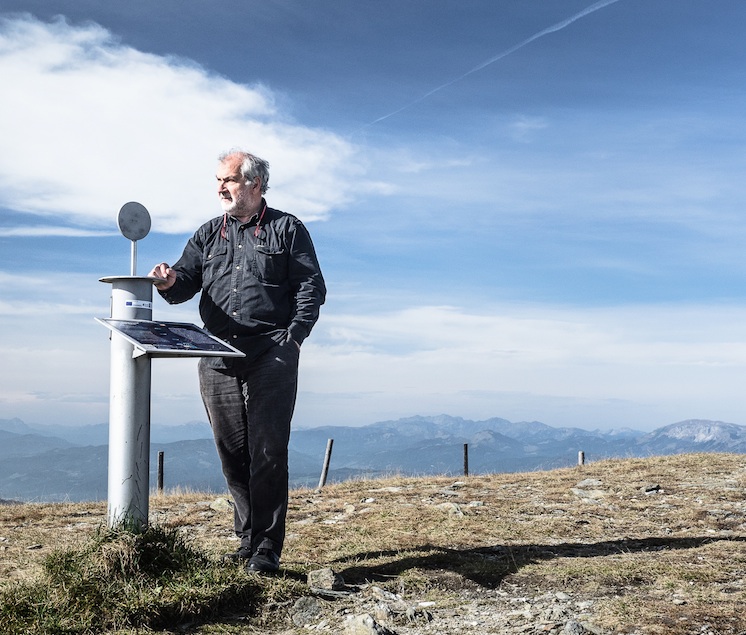
The spatial situation of this conjunction has left its mark already with the  Planet Trail “HEAVEN ON EARTH” in Rettenegg – Stuhleck in seven miles a landscape in the scale of 1: 1 billion.

The cosmic and calendrical situation on which the date CEP = 0 is focused, therefore, will not be in the shadow of all till now known temporal corner points.

We hope that Graz now, unfortunately for Johannes Kepler no lucky residence, during the presentation of CEP will prove itself more tolerant, favourably inclined and is worthy for its slogan “GRAZ ANYTHING GOES”.

The location of the three dimensional Shadow building of the Clock tower, that shows hours and minutes with its hands in reverse manner, was consciously chosen in order to present this new possibility of measuring time near to an optical parallel.  

The day number of public presentation (CEP 245500) may be an additional riddle for numerologists, giving the hours of the day and the year of Christ’s birth in the Anno Mundi count.

Further historical information will be found on the website Adjustment of AD.

More information on new time concept, please see CEP.


CEP -245,492 (30th Jan, 0003) after finishing of construction works,
1000 days after 5th May 2000, CEP -246,492